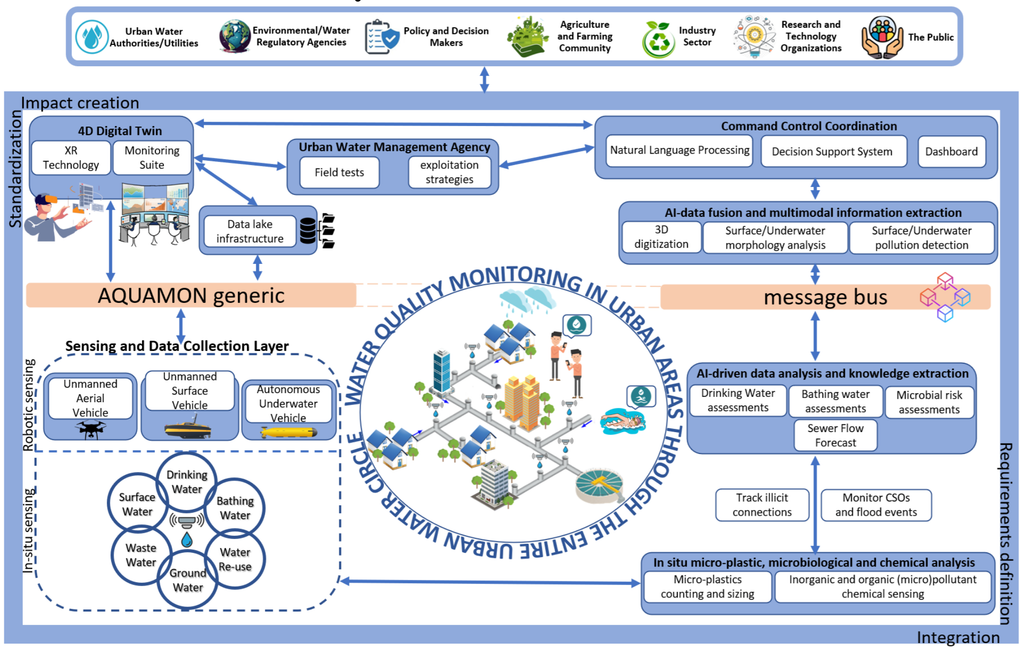
To turn raw measurements into meaningful insights, AQUAMON integrates sensor and robotic data into a powerful multimodal analytics environment. This environment brings together information from different monitoring technologies and data sources, allowing complex patterns to be analysed in a more coherent and comprehensive way. A suite of explainable AI (XAI) models interprets this information to forecast sewer flows, predict bathing-water quality, and support microbial and chemical risk assessments relevant to drinking water, wastewater and water reuse. By making analytical results more transparent and understandable, XAI helps users not only obtain predictions, but also better understand the factors influencing them.
A central component is the AQUAMON 4D Digital Twin—a dynamic virtual replica of the entire urban water network. This environment merges real-time measurements, simulation models and historical datasets to provide an up-to-date representation of system conditions. It enables users to visualise how the network is performing, explore possible future scenarios, and assess the potential consequences of pollution events or infrastructure failures before taking action. By combining observed data with predictive modelling, the Digital Twin supports faster and more informed operational and strategic decisions.
The 4D Digital Twin also provides a common environment in which different types of information can be viewed together, helping users understand relationships between water quality, infrastructure behaviour and changing environmental conditions. This integrated perspective is particularly valuable during rapidly developing events, when operators need to interpret large volumes of information quickly and identify the most appropriate response.
Security and accessibility are strengthened through blockchain-based data integrity, helping ensure that monitoring and analytical information remains trustworthy and traceable throughout the system. AQUAMON also incorporates extended-reality (XR) tools that can support immersive inspection, visualisation and training activities, making complex infrastructure and data easier to explore. In parallel, natural-language interfaces allow users to interact with the platform in a more intuitive way, reducing the need for specialised technical knowledge when accessing information or exploring system conditions.
These tools are designed to make advanced analytics more usable for a wide range of stakeholders, including utilities, regulators, technical operators and decision-makers. Instead of presenting users with isolated datasets or highly technical outputs, AQUAMON combines information into interfaces that support interpretation, communication and practical decision-making.
Together, these innovations transform complex environmental data into actionable intelligence for utilities, regulators and decision-makers. By combining multimodal analytics, explainable AI, digital-twin technology, secure data management and intuitive interfaces, AQUAMON supports earlier detection of risks, improved understanding of system behaviour and faster response to emerging problems. The result is a more connected and intelligent approach to urban water management, contributing to a safer, more resilient and more sustainable water future.